Explore Our Comprehensive Resource Library

RESCALED library on detention houses and justice reform

Explore a curated library that brings together diverse knowledge resources on detention houses, designed to support learning, inform justice reform and public debate.

Please not that this library currently only includes a selection of resources relevant to the Knowledge Workspace Women launch. Full library coming soon
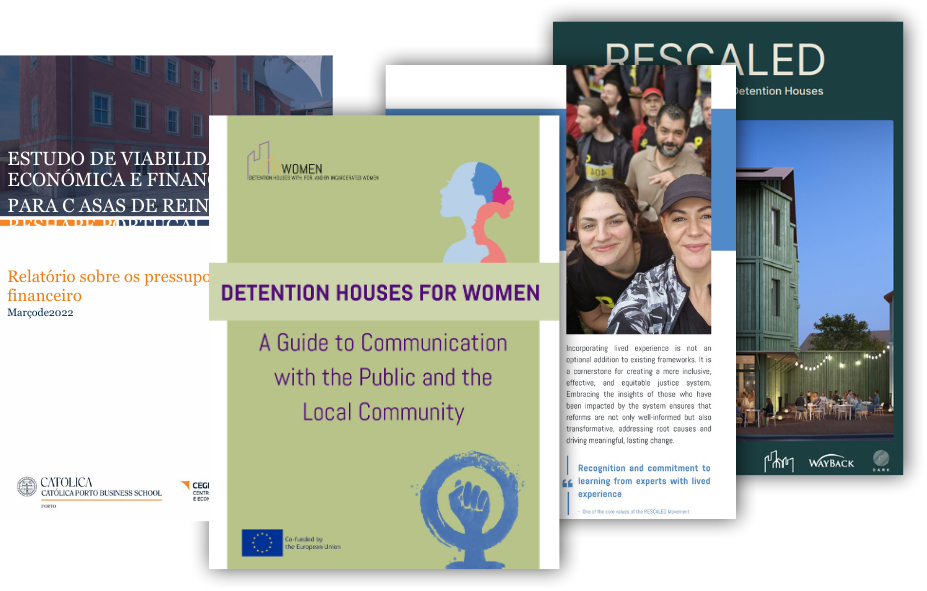
RESCALED-Academy-Library.png

Find Your Resources

Utilize our search bar to quickly locate specific reports, articles, presentations, and videos that meet your research needs. Use our advanced filters to better refine your search.

Language
Project
Document type
Filter by Level
Country
Filter by Keywords

Visietekst: Kwartiermaken en het detentiehuis

Kwartiermaken is een militaire term waarbij een voorhoede vooruitloopt om een veilige, gastvrije plaats te creëren, zodat de rest van het leger daar zonder extra nspanning gebruik van kan maken. Kwartiermakers zijn dus bruggenbouwers en spoorleggers. Ze scheppen voorwaarden voor veilige plaatsen waar mensen die uitgesloten worden welkom zijn. Ze werken aan een inclusieve gemeenschap waarin kwetsbare mensen niet alleen aanvaard worden, maar ook van betekenis kunnen zijn voor anderen. Wederkerigheid is voor sommigen belangrijk om er weer bij te horen. Kwartiermakers werken doelgroepgericht met personen in een kwetsbare of gemarginaliseerde positie en versterken samenwerking en solidariteit als hefboom voor inclusie. Verbinding staat centraal.

read more…

Vision Paper: Quartermaking and the Detention House

English version (translated from Dutch original): Quartermaking is a military term referring to an advance party moving ahead to create a safe and welcoming place, so that the rest of the army can make use of it without additional effort. Quartermakers are therefore bridge-builders and pathfinders. They create the conditions for safe spaces where people who are excluded are made welcome. They work towards an inclusive community in which vulnerable people are not only accepted, but can also be meaningful to others. For some, reciprocity is important in order to belong again. Quartermakers work in a target-group-oriented way with people in vulnerable or marginalised positions, and strengthen cooperation and solidarity as levers for inclusion. Connection is central.

read more…

Scottish Prisons Assessment and Review of Outcomes for Women(SPAROW)

This report presents findings from the Scottish Prison Service Assessment and Review of Outcomes for Women (SPAROW) evaluation, commissioned by the Scottish Government Justice Analytical Services. The primary purpose was to evaluate the early impact and emerging outcomes of the Scottish Prison Service (SPS) new custodial arrangements for women and the application of the SPS Strategy for Women in Custody 2021-2025. This was carried out in the context of the recently established Community Custody Units (CCUs) which heralded a new approach to the custody of women in Scotland.

read more…

Breaking out of theJustice Loop:

Breaking out of the Justice Loop: Creating a criminal justice system that works for women, by Naomi Delap (Director, Birth Companions) and Liz Hogarth (Independent women’s justice expert), examines why the justice system continues to fail women, and what needs to change.

National Women’s Justice Coalition logoIt is being co-published in partnership with the National Women’s Justice Coalition.

Our justice system, designed for men, is not working for women. Our prisons are full of trauma: over 60 per cent of women in prison have experienced domestic violence and more than half have experienced abuse as a child. Our prisons are bad at rehabilitating and deterring women from further offending; instead, they actively harm them and their children. Racially minoritised women are further disadvantaged: overrepresented at every point in the system and more likely than white women to be remanded and receive a sentence in the Crown Court. The human and financial cost of the system’s failure is significant.

read more…

‘Exceptional’ Open Prisons Under Pressure:Austerity, Instability and Distrust

This article examines the impact of various challenges on two Norwegian low-security prisons, Bastøy and Leira, during a particularly demanding period. Using ethnographic fieldwork and in-depth interviews with 51 prisoners, the article applies the conceptual metaphors ‘depth’, ‘weight’, and ‘tightness’ to explore the severity of control, restriction and psychological burden. Findings reveal a reduction in activities and an increase in restrictiveness in both prisons. Additionally, pris- oners at Bastøy noticed reduced staff presence and deteriorated trust, possibly due to the prison’s larger size, workplace conflicts and complex restructuring process, exacerbated by COVID-19 restrictions and austerity measures. The results point to a diminishing ‘exceptionality’ in Norwegian prisons, highlighting the importance of stability, institutional autonomy, and smaller prison size in fostering trust and close relationships.

read more…

Prison Service Journal (No 277) March 2025

This special edition of Prison Service Journal focusses on the issues of women, criminalisation and the need for differential approaches that recognise the part that gender plays in women’s pathways into the criminal justice system.

read more…

From poverty to punishment

From Poverty to punishment: Examining laws and practices which criminalise women due to poverty or status worldwide exposes how laws and policies disproportionately criminalise women due to their socio-economic status and vulnerabilities. Published by Penal Reform International and Women Beyond Walls—both members of the Global Campaign to Decriminalise Poverty and Status—the report calls for urgent reforms to stop the criminalisation of women for poverty, survival strategies and gendered norms.

read more…

Explore Our Video Library

RESCALED – Support the use of detention houses instead of large prison institutions
Let’s Talk RESCALED — Introducing RESCALED, a movement for justice reform
INSPIRE – the ecosystem of a detention house